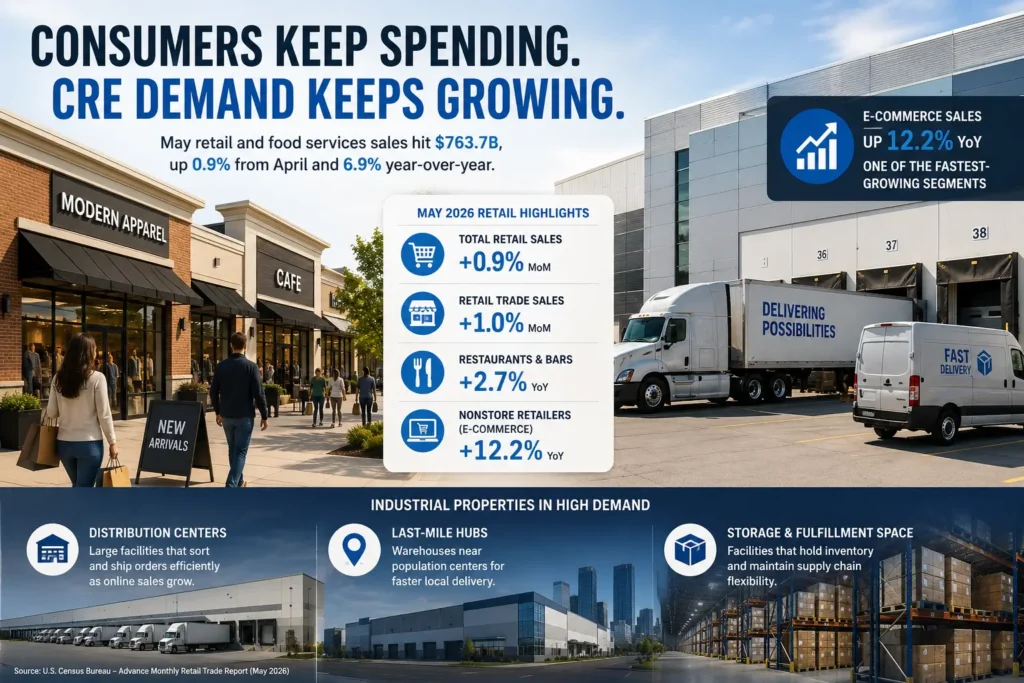
American consumers keep spending. According to U.S. Census Bureau data released June 17, 2026, retail and food services sales for May hit $763.7 billion, which is a 0.9% jump from the previous month. This outpaces April’s growth, which was revised down slightly to 0.4%.
On an annual basis, overall sales rose 6.9% compared to May 2025. The March-to-May stretch saw a 5.3% year-over-year increase. For commercial real estate (CRE) markets, this steady spending directly drives demand for logistics hubs and physical storefronts.
Traditional brick-and-mortar stores continue to demonstrate resilience. Retail trade sales rose 1.0% from April and 7.5% year-over-year, while spending at restaurants and bars increased 2.7% annually. These gains indicate that consumers are still actively shopping, dining, and spending in physical locations.
Higher sales volumes benefit neighborhood shopping centers, strip malls, and retail corridors. Stronger revenues give retailers greater confidence to sign long-term leases, meet rent obligations, invest in store improvements, and expand into new markets. As retailers continue to perform well, demand for well-located retail space remains supported by healthy consumer spending trends.
| Retail Category / Sector | Month-over-Month (MoM) Change |
| Total Retail Sales | +0.9% |
| Gasoline stations | +3.4% |
| Miscellaneous store retailers | +2.3% |
| Nonstore retailers (E-commerce) | +1.5% |
| Autos | +1.2% |
| Furniture stores | +1.0% |
| Retail Sales (Excluding Gasoline Stations) | +0.7% |
| Core Retail Sales (GDP Control Group)* | +0.7% |
| Health and personal care stores | +0.6% |
| General merchandise stores | +0.4% |
| Clothing and clothing accessories stores | +0.3% |
| Sporting goods, hobby, musical instrument, & book stores | +0.3% |
| Building material & garden equipment | 0.0% (Flat) |
| Food and beverages stores | 0.0% (Flat) |
| Food services and drinking places | -0.1% |
| Electronics & appliance stores | -0.5% |
Source: Advance Monthly Retail Trade Report Tables
While physical retail remains strong, industrial real estate is benefiting from the continued expansion of e-commerce. Nonstore retailers, which primarily include online sellers, recorded a 12.2% year-over-year increase in sales, making it one of the fastest-growing retail segments.
This growth creates demand for several types of industrial properties:
As e-commerce sales continue to grow alongside traditional retail spending, industrial landlords benefit from a steady need for modern logistics facilities. Rather than replacing physical stores, online retail is creating additional demand across the commercial real estate sector, supporting both retail and industrial property owners.
The data shows minor variations. For example, spending at bars and restaurants dipped 0.1% month-over-month, even though annual gains remained positive. Still, the broader trend is clear.
Consumers remain active across both digital and physical channels. For industrial and retail property owners, this economic environment provides a stable baseline heading into the second half of the year. Spending is up, operational footprints are busy, and underlying real estate demand remains firm.
